
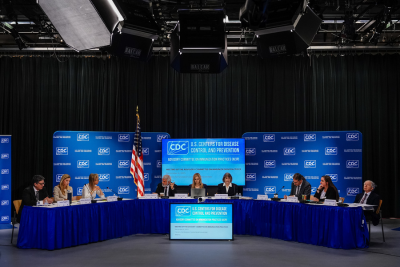
Upending decades-old guidance, the Centers for Disease Control and Prevention’s vaccine advisory committee voted to no longer issue a blanket recommendation that all newborns receive a hepatitis B vaccine at birth. Throughout the meeting, many panelists made misleading claims about the vaccine.
Here, we address claims about the vaccine’s effectiveness and safety, as well as other countries’ vaccination policies.

A universal birth dose was first recommended in 1991, after risk-based approaches failed to reduce cases. Young children are the most likely to develop a chronic infection that can lead to liver cancer and other problems. In the decades since, rates of hepatitis B in children have fallen by 99%.
In an 8-to-3 vote on Dec. 5, the CDC’s Advisory Committee on Immunization Practices decided to end that policy. If accepted by the CDC director, parents of babies born to mothers who test negative for the virus will now be advised to discuss vaccination with a doctor to decide “when or if” to give the vaccine. For those who opt to forgo a birth dose, the panel “suggested” waiting at least two months to vaccinate.


